
Oroville's Previous Residents Sources
An Oroville house leaves different traces in different eras. The assessor and GIS establish the parcel now. The recorder supplies named parties to a transaction. Directories and census schedules show households at a point in time, while maps and permits test whether the building and address fit. The table keeps those questions separate before the backward search begins.
| Source | Years It Covers | Where Held | What It Shows |
|---|---|---|---|
| Assessor parcel detail | Current | Butte County Parcel Search | APN, situs, legal shorthand, values, and exemptions |
| Recorder Self-Service Web index | Online start year not stated | Butte County Clerk-Recorder | Party, recording, document, and legal-reference leads |
| Earlier deeds and recorded maps | County formation era forward; series gaps unverified | Recorder and Archives | Grantor-grantee chain, legal description, parent parcel, and splits |
| Historical city directories | 1881, 1898, 1904-05, 1907, 1909-10, selected Polk years through 1950 | CSU Chico and Butte County Library | Occupants, addresses, occupations, spouses, and reverse entries |
| Federal census schedules | 1850-1950 presently public | NARA, FamilySearch, and library databases | Households at an enumeration place |
| 1852 California census | 1852 | State Archives and State Library | Early Gold Rush-era residents in Butte County |
| Building permits | Generally 1962 forward in unincorporated county | County Development Services or Oroville permit portal | Construction clues, applicants, and public documents |
| Sanborn fire-insurance maps | Oroville 1926 anchor | Library of Congress and CSU Chico | Footprint, use, materials, lot context, and street numbers |
| Obituaries and probate | Date-specific | Library, Superior Court, and Historical Society | Death, relatives, heirs, and reasons a name leaves a roll |
The recorder's public landing page does not state the first online year. That unknown matters. Older work may need the counter, a copy request, Archives help, a library search, or a narrow public-records request instead of an assumed digital cutoff.
Start Oroville's Previous Residents With APN
The Butte County Parcel Search and Assessed Value Lookup accepts an APN or street address. Its stated detail includes APN, property status, situs address, abbreviated legal description, land value, improvement value, exemption amount, and total assessed value. It does not promise unrestricted owner-name or owner-mailing-address display. The assessor office at 25 County Center Drive, 530-552-3800, is the fallback for a parcel question.
Situs means the physical place taxed by the parcel record. It is not proof that the owner lives there. A mailing address may point to a second home, trust, manager, or post-office box. The APN is more stable than a street line when a house has changed names, numbers, or use.
Butte County's Data Search and Public Works map viewers accept an address or APN and add parcels, city limits, addresses, zoning, flood areas, planning, permits, code cases, and recorded-map context. Parcel polygons are assessor-map representations, not survey-grade boundaries. Use the map to find the legal identity and surrounding geography, then use the deed for title evidence.
Note: The APN is the bridge from a changing address to a stable parcel question, not a shortcut to every past occupant.
Trace Oroville's Previous Residents Backward
The backward chain starts with the current APN and the most recent recorded acquisition instrument. Open the Butte County Clerk-Recorder Self-Service index, accept its disclaimer, and treat the result as a library-card-catalog lead rather than the document itself. The index is session-based and may time out. Search spelling variations, initials, punctuation, trust names, and entity suffixes.
- Save the assessor APN, situs, abbreviated legal description, and any parent-parcel clue.
- Search the current party in the recorder index by name and a narrow date range, then note the document number, type, date, book or page, and legal reference.
- Read the purchase deed and copy the seller, or grantor, plus the legal description exactly as recorded.
- Search that seller as an earlier grantee. Match the same land description or predecessor APN before accepting a name as part of the chain.
- Repeat backward. If the online trail stops, use the Clerk-Recorder counter at 155 Nelson Avenue, Archives, mail, or a focused copy request.
- Grantor and grantee
- The grantor transfers an interest. The grantee receives it. A deed can show both roles without proving that either person lived at the parcel.
- Chain of title
- The linked sequence of recorded transfers that connects a current instrument to earlier instruments.
- Legal description
- The formal land description, such as a lot, block, subdivision, or metes-and-bounds description, that can outlast a street label.
- Index versus image
- The index points to a record. The document image or certified copy supplies the text needed to check names, signatures, parties, and land.
The recorder also offers counter and mail channels. Online copy ordering requires a party name and Document ID, while a complete document or certified copy is a separate product from a free index result.
Map Oroville's Past Households
Parcel splits can make a straight address search fail. A parent parcel may divide into two lots. A subdivision may assign new APNs. A recorded map may preserve the old tract name while a later deed uses a new parcel number. Search the deed's legal description, parent APN, Book-Page-Parcel parts, and recorded map references together.
For example, an APN such as 036-011-015 uses Book 36, Page 01, Parcel 15 in the county's parcel logic. That format is a research key, not a survey. Click the parcel in GIS, inspect the parent or alternate identifier, and compare the map with the recorder instrument before connecting two addresses.
Past occupants may be hidden by a change in route, rural address, annexation, or street number. Keep the old and new wording in the search notes. A matching legal description is stronger than a similar street name, and a matching deed is stronger than a shared surname.
Oroville's Pre-1962 Permit Seam
Permit history depends on jurisdiction. For unincorporated Butte County property, building-permit documents generally do not exist before 1962. The county's address and APN search instructions describe the eTRAKiT path: choose Address or Parcel Number, enter the value, select a result, and use “View Public Property Documents.” Older documents may be bundled under an APN-labeled file, so scroll through the result.
| Search By | Required dropdown: Address or Parcel Number. |
|---|---|
| Search value | Required text. For an address, omit “street,” “road,” and abbreviations; an APN can use the county format. |
| Public documents | Open after selecting a result; multiple documents may require scrolling. |
| County fallback | Development Services, 530-552-3700, dsbuilding@buttecounty.net. Water and sewer records go to Environmental Health at 530-538-7281. |
A no-result screen is not proof that no work took place. For an incorporated Oroville parcel, use the Oroville Public Works permit page, its online application, paper forms, or the City Hall counter at 1735 Montgomery Street. City engineering applications include lot-line adjustments, parcel mergers, encroachment permits, and related land work. County and city records are separate channels.
Oroville Resident History in Directories
Owners are only one layer of the past household trail. The historical collection includes the 1881 McKinney volume, 1898 Ensign, 1904-05 Scollard, 1907, 1909 and 1910 Chico-Oroville titles, and selected Polk years through 1950. Reverse or criss-cross pages can start with a street and house number. The missing years remain gaps, so a name should be followed across adjacent surviving volumes.
The collections themselves are described in the Oroville directory book. Pair a directory entry with the federal census for 1940 or 1950, then use the 1852 California census for earlier Gold Rush-era work. The State Library guide and State Archives material help explain the 1852 source. The 1950 schedule is presently the latest public federal population schedule under the 72-year rule.
- Copy the entry as printed, including spouse, occupation, house mark, address, and page.
- Check the next available directory year, then the prior available year, and mark every missing volume.
- Compare the address with a census enumeration place, deed, map, or permit before calling an occupant an owner.
- Ask the library for an obituary or newspaper article when a household disappears, then test the result against probate or cemetery evidence.
That sequence lets directories answer who was associated with a house without asking a deed to prove occupancy or a census to prove title.
Verify Oroville Past Residents With Sanborns
A Sanborn sheet can test whether a historic address makes physical sense. The Library of Congress collection and the CSU Chico Butte County Fire Insurance Map Collection provide map access, including an Oroville 1926 anchor. The sheet may show a building footprint, use, materials, lot context, and street number. It will not list every person in the building.
Use the map beside the directory entry and deed. A rear-house notation, a changed street number, or a building that appears after a gap can point to the right parcel. The legal description and recorded map still control the land connection, while the Sanborn supplies structure and address context.
Note: Sanborn evidence can support a building timeline, but it cannot turn an occupant clue into a title record or a complete household list.
Close Oroville's Past Resident Trail
Probate and obituary records often explain why a name leaves a directory. A probate petition or notice may identify a decedent, petitioner, heirs, or devisees where the file is public. A deed can show a later transfer. An obituary can add a spouse, child, cemetery, former address, or community tie. These clues should be checked against the source document and not treated as proof of every family relationship.
The county custody split matters. Public Health holds current and one prior year birth and death records. The Clerk-Recorder handles older local certificates, and the California Department of Public Health is the statewide custodian. California does not make certified vital records open after a simple number of years. Health and Safety Code sections 103525-103526 distinguish authorized copies from informational copies, which are marked not valid to establish identity.
The Butte County certificate-fee page records the 2026 local amounts, including $31 for a birth certificate and $26 for a death certificate.
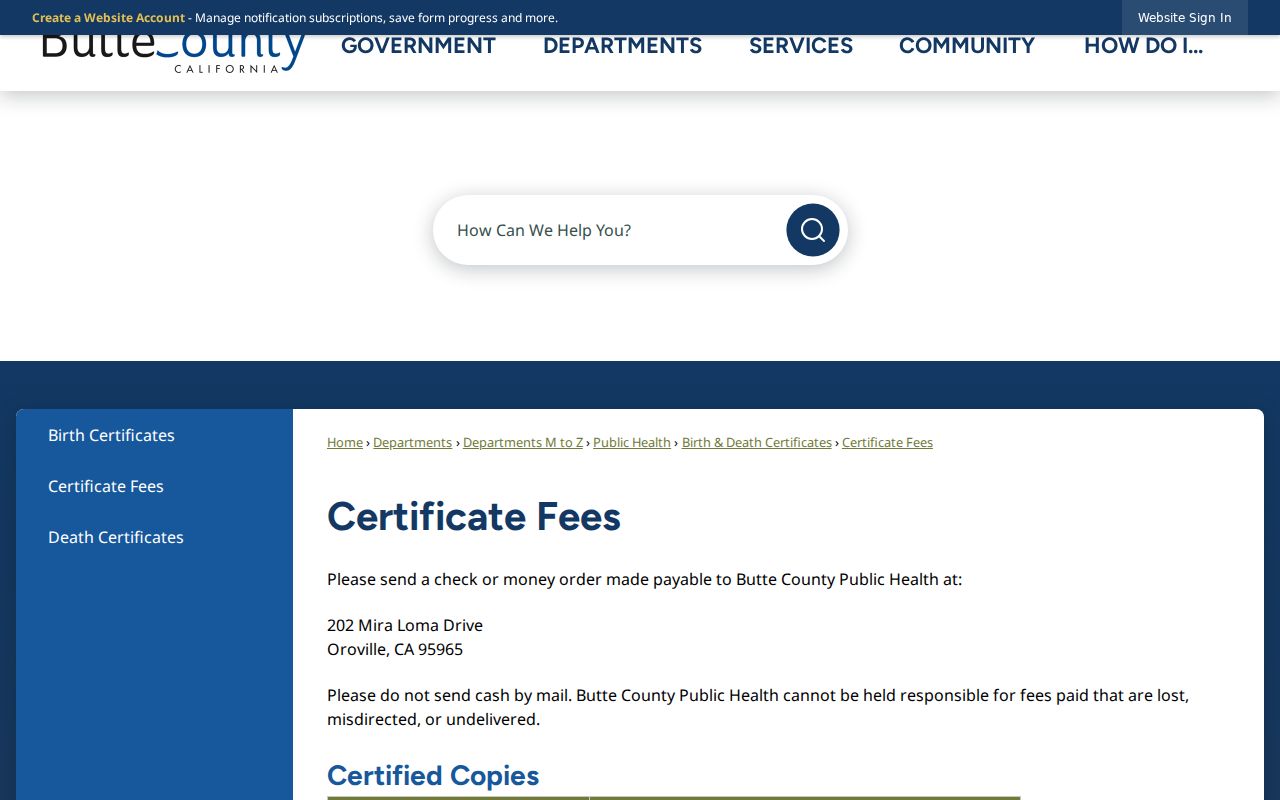
The fee reference helps separate a local application channel from the free historical index. It does not make a restricted certified copy available to every requester.
The Butte County birth and death records page explains the local registrar split and points to application routes. Mail requests may require a notarized signature for an authorized copy. Historical gaps can be addressed with the library's pre-1905 death material, California death records for 1940-1997, newspaper and obituary requests, cemetery evidence, church registers, the Historical Society, and probate files.
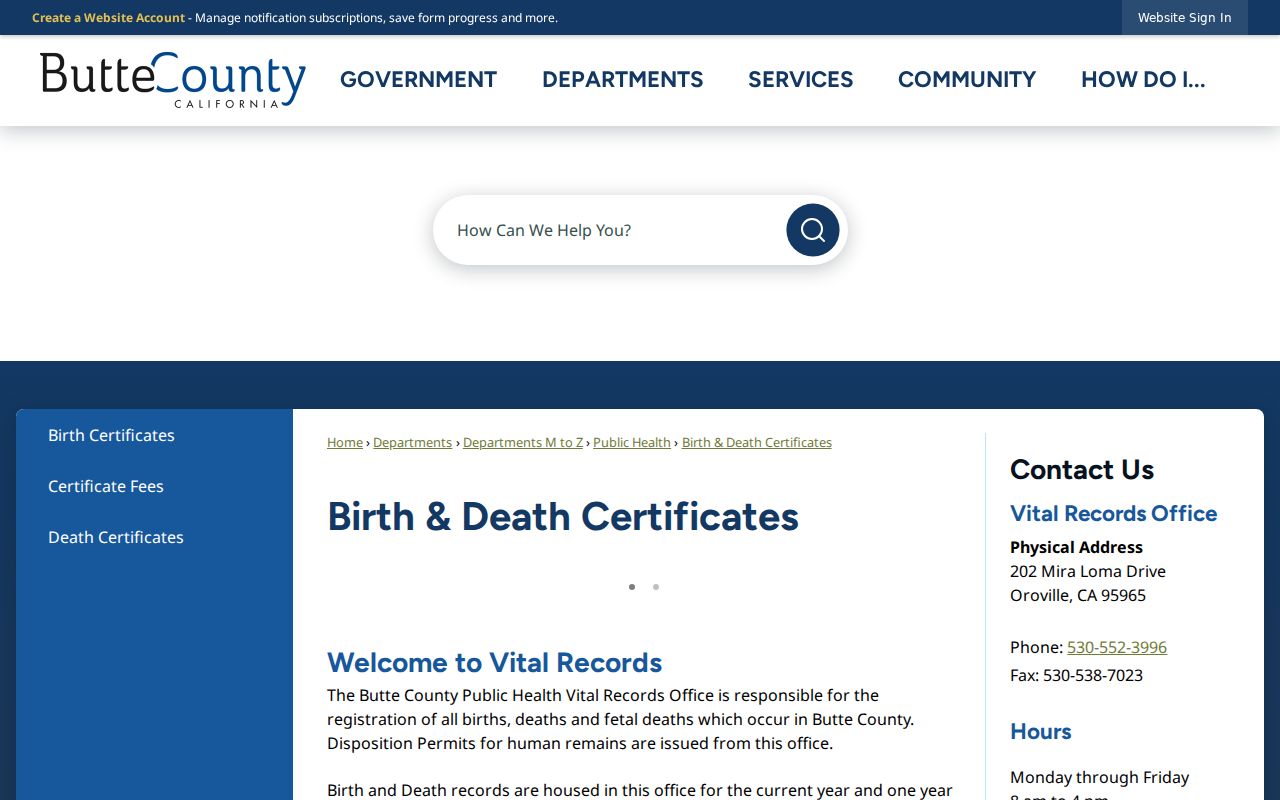
The custody page is the right follow-up when a previous-resident clue needs an official birth or death record, while an obituary or probate file may remain the better route for family context.
Normalize Oroville Address History
Normalize each address without erasing the old form. A postal city, incorporated boundary, county permit jurisdiction, assessor situs, mailing address, and legal description are separate labels. “Oroville” can appear on an address tied to Thermalito, South Oroville, Palermo, Kelly Ridge, or another county-served area. The Oroville district map and county parcel GIS help establish which office created a record.
Camp Fire rebuilding adds another continuity seam across Butte County. A pre-fire mailing line may differ from a later permit. A rebuilt structure can carry a recent permit history on an older parcel. An owner may receive mail elsewhere while the APN and legal description remain the same. Keep pre-fire directory, Sanborn, deed, and assessor evidence beside post-fire permit and parcel records.
Address normalization is a research aid, not a reason to merge people. Keep the source spelling, date, APN, legal description, and jurisdiction in separate fields. A matching parcel plus a matching document is stronger than a similar street line.
Lawful Oroville House History
When an online trail stops, use the access channel that fits the record: the Clerk-Recorder counter or mail route, County Archives, Butte County Library staff and microfilm, the Historical Society, State Library and State Archives research rooms, or a narrow request through the Butte County public-records portal. Identify the record type, date span, address, APN, person, and known document number. A focused request is easier to search than an open-ended demand for every past resident.
Lawful house history. Past-resident research can support family history, estate work, or a lawful question about a property. It does not authorize repeated contact, surveillance, threats, or attempts to identify protected people. California Penal Code section 646.9 and related harassment remedies still apply.
A past name in a deed, directory, probate file, or obituary is a dated record clue. It is not permission to pursue a living person, infer a private household, or treat a public entry as a complete account of who lived at an address.