
Oroville's Directory Shelf
The Butte County Library genealogy page is the local starting point for the Historical Butte directories project made with CSU Chico. The CSU Chico digital collection supplies free scans and OCR, while library staff, branch resources, and local history holdings provide a fallback when a scan is hard to read. A volume is a dated finding aid, so the imprint, publisher, volume, and page matter as much as the name.
| Collection | Years | Where Held | Access |
|---|---|---|---|
| L. M. McKinney and Co. | 1881 | CSU Chico and Butte County Library project | Free scan and OCR; page 377 |
| H. U. Ensign, Chico City Directory | 1898 | CSU Chico digital collection | Free browse, scan, and OCR |
| Scollard Directory Co., Chico City Directory | 1904-05 | CSU Chico digital collection | Free browse, scan, and OCR |
| Directory Publishing Co. and Crick's Bookstore | 1907 | CSU Chico digital collection | Free browse and scan |
| Directory Publishing Co., Chico-Oroville Directory | 1909, 1910 | CSU Chico digital collection | Free browse, scan, and OCR |
| R. L. Polk and Polk volumes | Selected years through 1950 | CSU Chico and partner library holdings | Free scans where digitized |
The selected Polk years are 1911-1916, 1918, 1921-1924, 1926-1927, 1929, 1931, 1933-1934, 1935, 1937, 1939-1940, 1945, 1948, and 1950. The contributing libraries do not hold every year from 1882-1904 except the separately held 1898 and 1904-05 volumes. They also lack 1917, 1919, 1920, and 1925. Those absences describe the surviving collection, not the presence or absence of an Oroville family.
Note: A missing scan year is a collection gap, not evidence that an Oroville household vanished from the record.
Oroville's Directory Scan Story
Local volumes were deteriorating when Friends groups helped fund scanning, restoration, and rebinding in 2004. That work explains why an Oroville volume set can be read at no charge even though the physical sets are partial. Searchable OCR is a useful first pass, but letters, initials, street names, and small marks need to be checked against the page image.
The first local directory appeared in 1881. Publisher changes then shift the way occupations, spouses, firms, householder marks, and streets are shown. A researcher who records the title page and abbreviation key can tell a true change in a household from a change in editorial style.
The California State Library genealogy holdings add a statewide and county-history path for names that do not resolve in the local scan set.
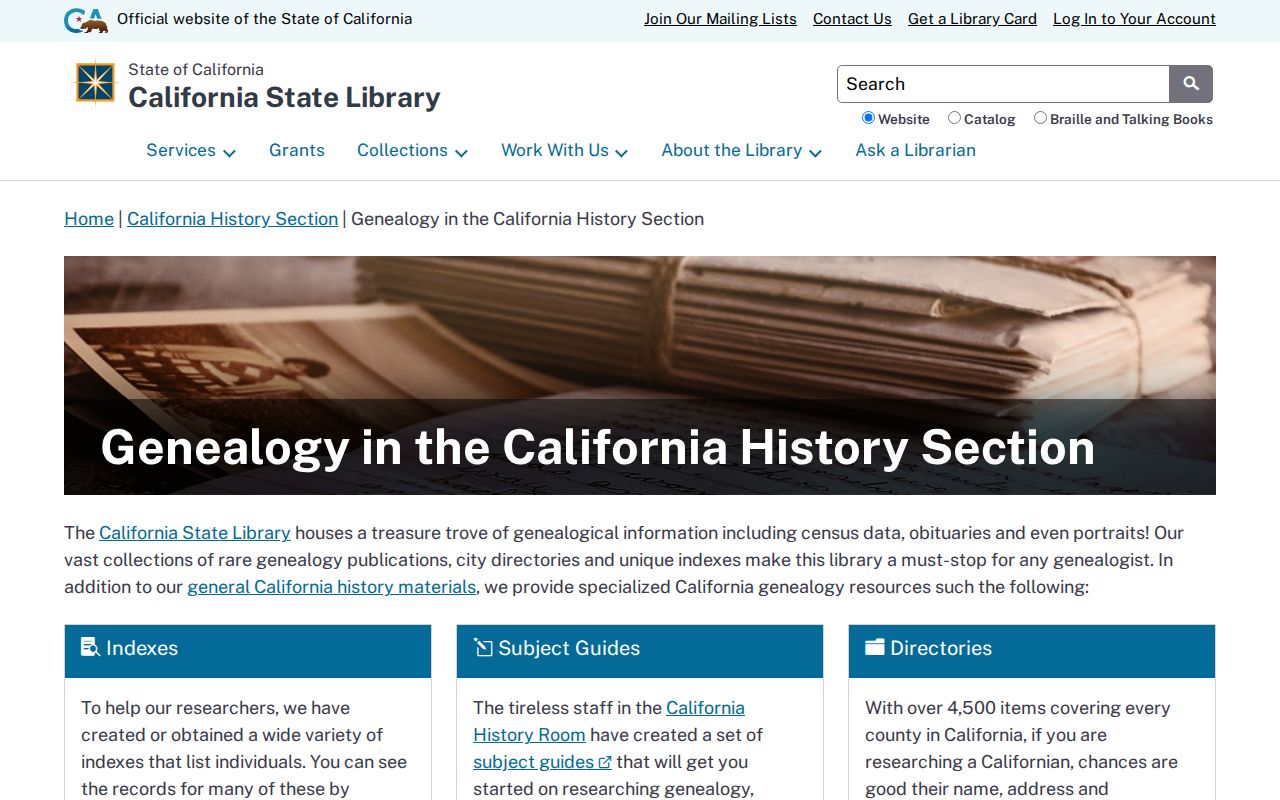
The California State Library resource is most useful when a local directory clue needs a census, genealogy, or state-collection check rather than another pass through the same OCR.
| 1881 | First local directory identified in the CSU Chico and library project. |
|---|---|
| 1898 and 1904-05 | Separate surviving volumes bridge part of the early collection gap. |
| 1907 to 1910 | Directory Publishing and Chico-Oroville titles change the imprint and coverage. |
| 1911 to 1950 | Selected R. L. Polk years continue the digitized run; 1950 is not proven to be the last printed volume. |
| 2004 | Friends-funded scanning, restoration, and rebinding protect the partial sets. |
Where Oroville's Directories Live
Butte County Library offers the online genealogy hub, branch and staff help, obituary and newspaper-article requests, and access to microfilm or licensed databases when a home connection cannot reach the needed run. CSU Chico's Meriam Library Special Collections and University Archives hold the digitized directory project, photographs, yearbooks, campus publications, and regional material. The free digital shelf is the quickest place to test a name, but the physical research desk is the better route for a volume or format that was never scanned.
The Butte County Historical Society archives can add photographs, vertical files, family material, and local knowledge. The Meriam guide to historical Butte County records points toward assessment, court, probate, naturalization, recorder, and vital holdings. For older statewide context, the California State Library's 1852 census research guide explains the Butte material and routes a researcher to the State Archives original, microfilm, or transcription and index resources.
The Historical Society is a useful fallback when an obituary, photograph, family file, or building clue fills a gap that a city directory cannot. Give an archivist a name, place, date range, and research purpose so a request can be tested against the right collection.
The archive side of local research is shown through the Historical Society's public collections page.
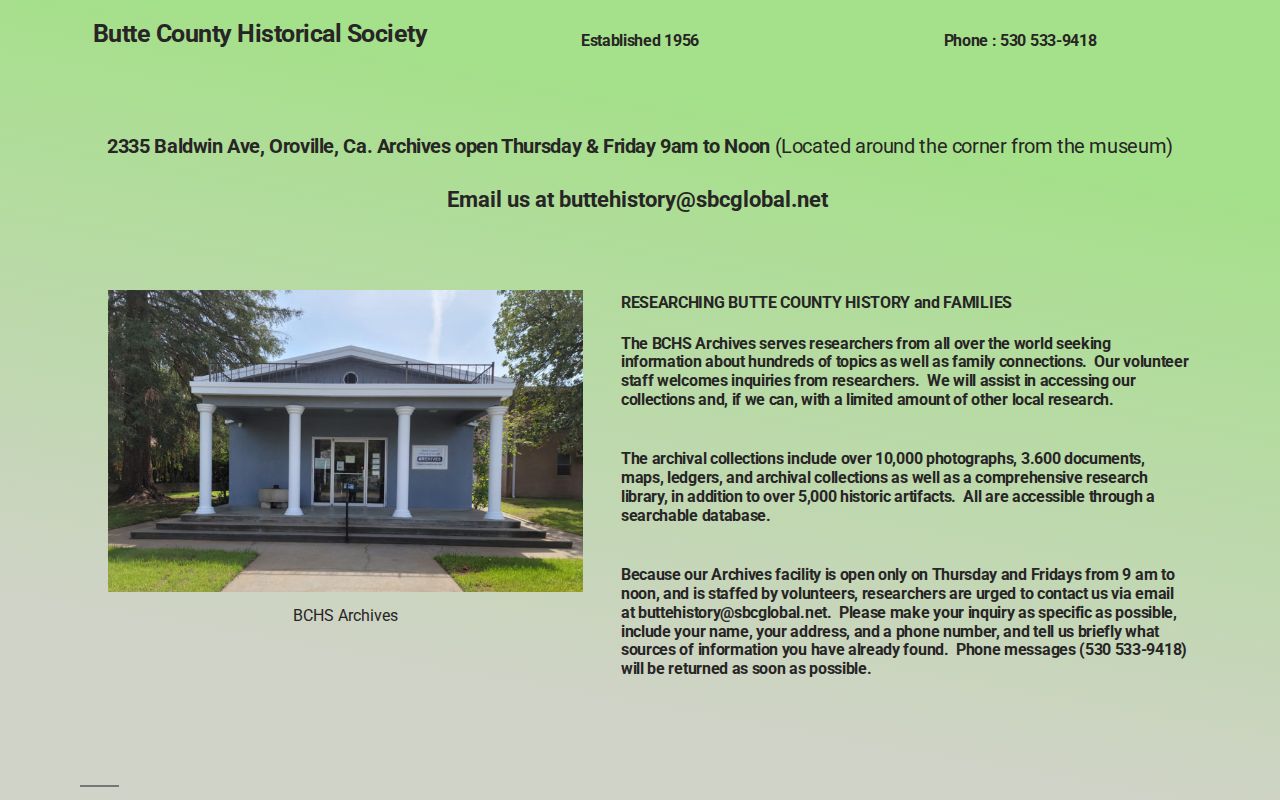
That archive connection helps preserve the difference between an indexed name, a family-history clue, and a document that actually proves an event or address.
Oroville's 1881 Directory Page 377
The 1881 McKinney scan at page 377 is headed for Butte County and Oroville. Its alphabetical run places personal names beside occupations, trades, firms in parentheses, employer wording such as “with” a named business, public roles, and, in some rural entries, acreage. It shows miners, farmers, laborers, carpenters, merchants, a jailer, physician, notary public, hotel driver, water-works agent, dressmaker, milliner, musician, saloon keeper, and engineers.
The page also shows why a city directory needs a second source. “Mrs Wm (widow)” gives a marital clue without a full independent given name. Vital records, probate, census schedules, newspapers, or an obituary may be needed to identify the person without silently expanding the name.
Advertising and OCR noise sit beside the entries. The scan proves an 1881 association with Oroville, an occupation, or a place in the volume. It does not prove a current address, legal ownership, or a living descendant.
Oroville's 1933 Polk Directory Page
The 1933 Polk scan at page 9642 supplies a second entry inventory. It shows a personal name, a spouse in parentheses, h beside a home address, r for rooms or residence with another household, wid with a deceased husband, an employer or business, a rear-house notation, and a business telephone.
Occupation shorthand includes lab, cook, carp, tchr, librn, and sten. Several entries at 418 Flume show how address grouping can reveal a shared lot or a rear unit. The marks are clues about the compiler's view of a household in that year, not a deed or a full list of everyone who lived there.
OCR can run words and characters together. Preserve the printed spelling, punctuation, initials, and page number before comparing the entry with a census or deed.
Decode Oroville Directory Marks
Later volumes may include alphabetical pages and criss-cross or reverse pages. The first route starts with a surname. The reverse route starts with a street and house number, then points to an occupant or telephone listing. Use the abbreviation key for that publisher and year. A mark that looks familiar can change meaning across a run.
- Criss-cross or reverse pages
- Street and house number lead to an occupant or telephone entry, which helps when a surname changed or an address is the known clue.
- Householder mark
- A publisher's
hor similar mark identifies the main household listing in that volume; it is not proof of title. - Residence mark
- The 1933
rmark can indicate residence or rooms with another household; read the key before expanding it. - Abbreviation key
- The publisher's legend defines marks such as
widand occupation shorthand. Photograph or cite it before relying on an expansion.
Owner and renter status should be tested against a deed, assessor parcel record, or other source. A directory entry can put a person at a place without resolving title, tenancy, or every household member.
Oroville Directory Gaps Need Context
The missing years are a research fact, not a blank to fill with guesses. The contributing libraries lack 1882-1904 except 1898 and 1904-05, plus 1917, 1919, 1920, and 1925. There is also no authoritative evidence in the research record for a post-1950 printed or criss-cross shelf run, or for 1950 as the final printed year.
When a name disappears, request an obituary or newspaper article through the Butte County Library service. The same page points to the pre-1905 Butte County Death Index, California death records for 1940-1997, the Social Security Death Index, FamilySearch, and local digitized newspapers. Staff and microfilm can help when a full newspaper database is not open from home.
Obituary evidence is still selective. A move, a new surname, a changed street, a missing listing, death, or an editorial choice can all break the chain. Use the Historical Society, census, deed, and map trails to test the reason.
Trace an Oroville City Directory Household
Household tracing works best as a dated sequence. Start with a name or address, then treat each volume as one observation rather than a continuous roll.
- Open a known year in the CSU Chico collection. Record the title page, page number, name as printed, address, occupation, spouse, and any mark.
- Move to the next available volume before and after the entry. Mark the collection gaps so an absent year is not mistaken for an absent household.
- Switch to street or reverse pages when the surname changes, initials shift, or the alphabetical listing stops.
- Pair 1940 and 1950 directory clues with the matching federal census. For earlier Oroville work, pair the 1852 California census with the State Library guide and State Archives material.
- Use a deed to separate occupant from owner, a Sanborn map to test whether the building and street number fit, and an obituary or probate file to explain a disappearance.
The 1852 census matters because rapid migration made the 1850 count difficult. The 1950 schedule is presently the latest public federal population schedule under the 72-year rule. Neither source should be forced to answer a question it was not designed to answer. Census households are tied to an enumeration place, while a directory was compiled before its imprint year and may use a different address convention.
Note: Pairing a directory scan with census, deed, map, and obituary evidence gives a stronger trail than any single name match.
Verify Historic Oroville Addresses
Sanborn maps provide a building check that a city directory cannot. The CSU Chico fire-insurance map collection and the Library of Congress Sanborn collection include an Oroville 1926 anchor. A sheet can show footprint, use, materials, lot context, and street numbering. It can also reveal why a rear-house entry or a changed number needs more than OCR.
Deeds and recorded maps then connect the historic address to a legal description, parent parcel, or later APN. Assessor maps are tax-purpose representations, so the recorded instrument controls a legal conclusion. When a modern parcel bridge is needed, the Oroville street directory workflow starts with the present address and APN before returning to the older volume.
Keep both forms of the address in notes. A railroad, mining-camp, ranch, river, township, rural route, or early street label may describe Oroville before a numbered street became stable.
Oroville Directory Limits Matter
An Oroville directory records what a compiler could gather for a particular publication. It may miss renters, people in institutions, workers in lodging, Indigenous residents, informal household members, or anyone who was not listed. A name may appear under a married name, an initial, an anglicized spelling, a business, or an employer association.
Oroville's Gold Rush setting, Feather River navigation, railroad history, Chinese Temple records, and later agricultural and university ties create many such naming shifts. Search the exact source spelling first. Then compare it with the 1852 census, the selected Polk years, newspaper or obituary material, deeds, and the 1926 Sanborn sheet. Keep a clear note of what each source actually shows.
The result is a careful historical directory trail: useful for family history, reconnecting with a past community, and studying a house or business, while staying honest about gaps, OCR, privacy, and the limits of a dated entry.