
Start an Oroville Residents Directory Search
Oroville names appear in several record systems, and each was built for a different job. The Butte County Assessor starts from a street address. It also works from an APN, the number assigned to a parcel of land. The Clerk-Recorder adds deeds and other recorded instruments. The Superior Court index adds party names and case events. For historical names, turn to the Butte County Library. CSU Chico's digitized Butte directories help too. So do newspapers and census schedules. A record the city itself created belongs with the Oroville City Clerk. It may instead sit with the department that made it. The mailing address alone does not decide custody.
The picture these systems give is useful but never complete. A parcel result links land, value, and tax facts. It does not list every resident. A deed names the parties to a transaction, not a whole household. A voter page authenticates one voter, not a public list. A directory entry pins a name to a date. It may show an occupation or spouse without proving a present address. Hold those limits in view while you follow the Oroville trail.
- Start with the known clue. Search the Butte County Parcel Search / Assessed Value Lookup by street address or APN when the trail begins at land.
- Save the parcel's APN, situs address, abbreviated legal description, and status. “Situs” means the physical location shown for the parcel, not a residence claim.
- Use the APN and legal description in the Butte County Clerk-Recorder Self-Service index, then obtain the underlying document when the record matters.
- For one person, compare the court index, license or business record, obituary, or eligible vital record while preserving spelling, dates, and locality.
- Move backward through the library's directories and census sources for family history, then ask the creating custodian for a narrow record that is not online.
Note: An official record can anchor a name, place, or event without proving a complete current household.
The Offices Behind Oroville Records
Oroville is the Butte County seat, so several counters sit close together even though their duties do not overlap. The Clerk-Recorder at 155 Nelson Avenue examines, images, indexes, and archives recorded instruments and maps. The Assessor at 25 County Center Drive keeps secured-roll values, parcel maps, and legal descriptions. Elections runs the voter-status and voter-file channels. The Superior Court sits at One Court Street. It keeps the case index and court files. City-created files start at City Hall, 1735 Montgomery Street.
Match the office to the record. The Butte County Clerk-Recorder handles deeds, liens, maps, marriages, fictitious business names, and other registrations. The Butte County Assessor is the parcel bridge. The California Secretary of State's My Voter Status portal is a self-check. Broader voter-file access requires a qualified purpose under California Elections Code §2194, a statute that guards the voter rolls.
Butte County Clerk-Recorder
155 Nelson Avenue
Oroville, CA 95965
530-552-3400
Butte County Assessor
25 County Center Drive
Oroville, CA
530-552-3800
Butte County Elections
Clerk-Recorder / Registrar channel
Oroville, CA
County contact varies by request
Oroville Parcel Search Before a Deed
The Butte County Parcel Search accepts an Assessor Parcel Number or a street address. An APN is a tax map key. It is not a street name. The public result describes the APN, property status, situs address, abbreviated legal description, land value, improvement value, exemption amount, and total assessed value. Vacant land may carry no street address at all. Then the APN is the stronger first clue.
The county does not document this search as an unrestricted owner-name directory. Read a parcel as a location bridge. Save its APN and legal description. Then test the recorded index for who signed a deed or other instrument tied to that land. The Butte County Data Search and Public Works viewers add zoning, flood, permit, code, and land-use context, though parcel polygons are tax-map drawings rather than survey-grade boundaries.
| Assessor field | What it contributes |
|---|---|
| APN | Book-Page-Parcel key, such as 036-011-015. |
| Situs Address | Physical parcel location shown by the assessor. |
| Legal Description | Short land description to compare with a recorded instrument. |
| Values and Exemption | Tax-roll context, not proof of occupancy. |
The Assessor's counter clarifies confusing parcel results. The office publishes 530-552-3800 and 25 County Center Drive. Keep the exact labels, since "situs" and mailing address answer different questions. The county's official Assessor page shows the public parcel-search entrance and its APN and address path:
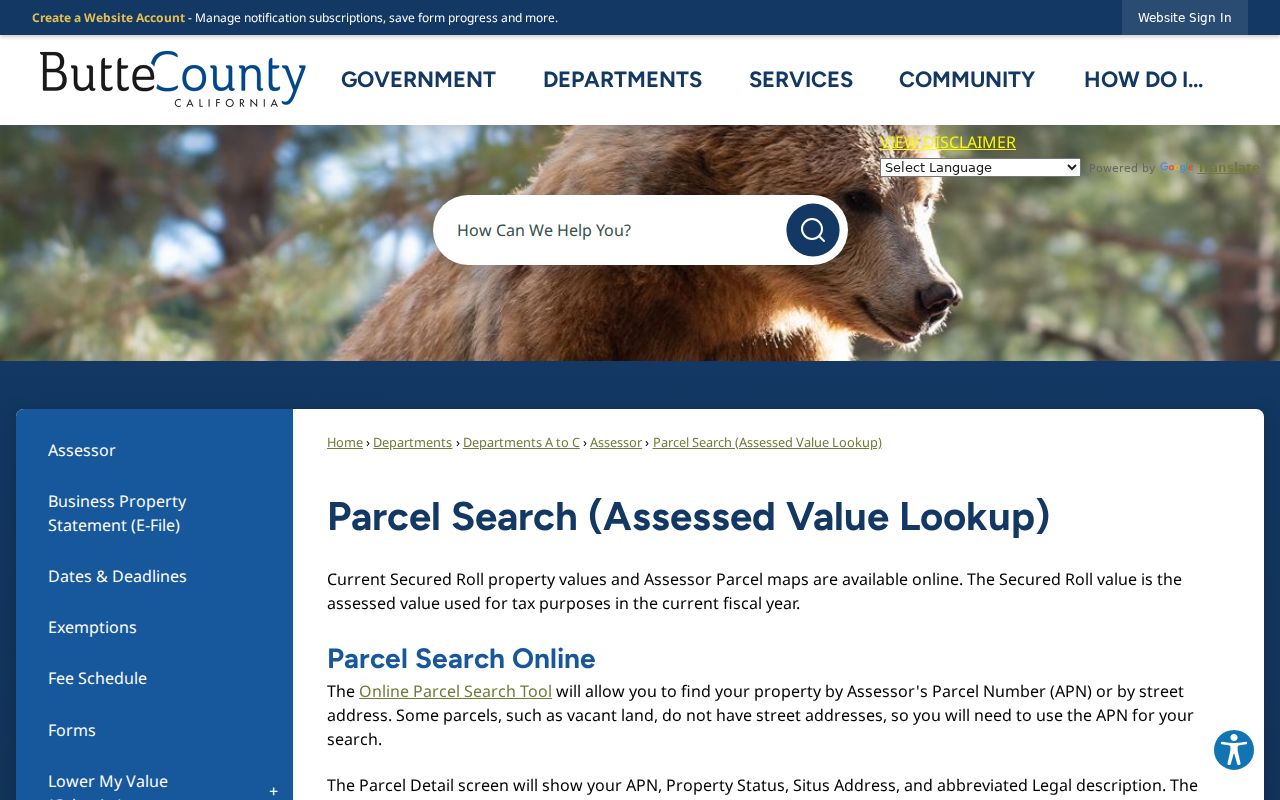
Put the parcel view first. Every Oroville residents directory trail benefits when deed, map, and permit searches share one land key from the start.
- Parcel
- A mapped unit of land identified by the assessor's APN.
- Situs
- The physical location assigned to the parcel, not a claim about who lives there.
- Index
- A finding aid that points to a record; it is not the full document.
- Criss-cross directory
- A historical directory arranged by street and house number rather than only by surname.
The Oroville Recorder Index
The Butte County official-record Self-Service index works like a library card catalogue. It points toward an instrument. It is not the deed image. Accept the disclaimer, then search every spelling variation. Try name punctuation, middle initials, and trust or entity suffixes too. The public landing page does not state a first online year, so no cutoff should be published without the custodian's word.
Use grantor and grantee roles as a chain. A grantor transfers an interest. A grantee receives it. Search the known party, the recording date range, document type, document number, book and page, and any legal or APN references. Then compare the copy against the assessor parcel. Online copy orders need the party name and Document ID, and recorder prices differ for regular, certified, and digital copies, so check the current county fee page before ordering.
A result can reveal a transaction, lien, map, or other recorded event, yet it cannot prove the person lived at the situs. The mailing address may differ from the land. That gap is what makes the recorder useful for identity control and prior-owner research. The assessor and GIS establish the land connection.
The county's official-record index page shows the card-catalogue entrance and its search path:
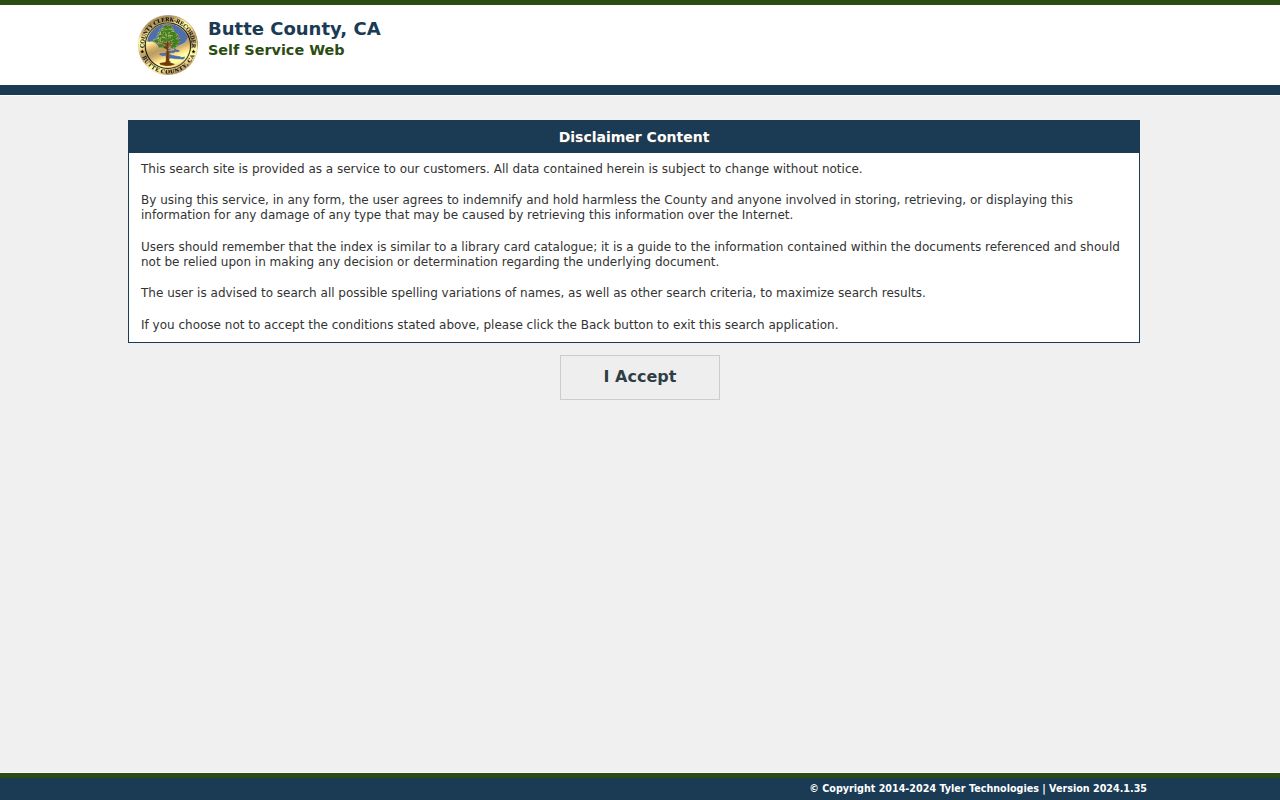
Write down each search term and document ID next to every Oroville residents directory lead. That way a clerk answers one focused question instead of an open-ended identity request.
Butte Court Records for Oroville
The Superior Court of California, County of Butte portal reaches nonconfidential civil, criminal, family, probate, small-claims, and traffic cases. It offers no life story in one view. A case number is one piece of evidence. A party role, filing date, status, hearing, register-of-actions entry, charge, or disposition is another. Each deserves its own note. Treat the record trail that way and it stays honest. Coverage has three legacy seams. Superior Court records reach back to 1988. North County Municipal filings start in late 1985, and South County Municipal in 1989. An older case can still surface if later activity landed after an electronic index existed. Ignore the 1/1/1900 date, a legacy-conversion placeholder rather than a real event. Juvenile, adoption, sealed, and confidential matters normally stay out of remote results.
| Portal control | Use | Oroville search note |
|---|---|---|
| Smart Search | Party name or case number | Required text field; CAPTCHA may appear. |
| Case type/filter | Narrow a result set | Civil, criminal, family, probate, small claims, traffic, and other listed types. |
| Search Hearings | Open hearing-calendar route | Separate mode from the main party search. |
| Register | Account control | Public search does not require an account. |
The Oroville courthouse sits at One Court Street. Check the portal page first online. The counter and the copy-request process still matter when a document is not lawfully remote. The manifest's Butte court source capture shows the case-information route:
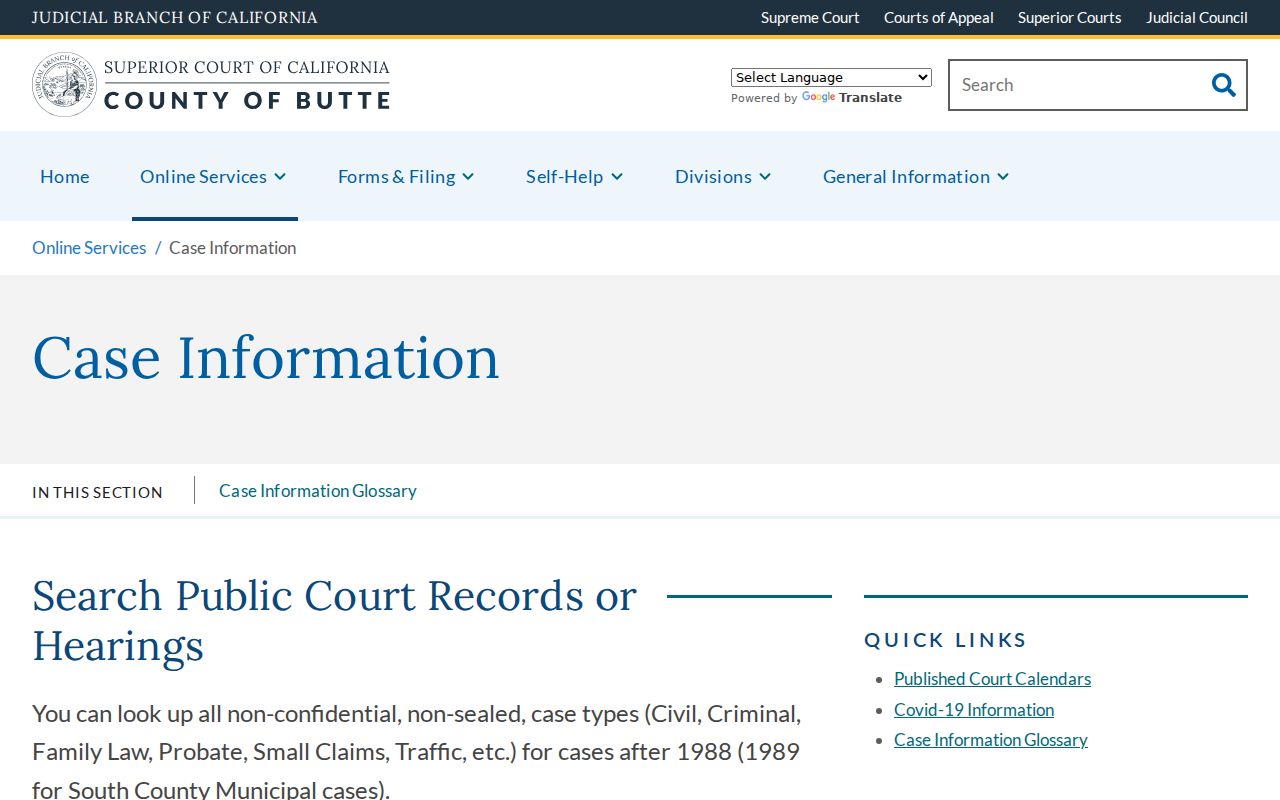
Federal cases involving an Oroville resident follow a different trail. Party and case searches for the Eastern District of California live in PACER, separate from the county portal.
Oroville Court Access Beyond the Web
Courthouse computers can display some public documents that California rules bar from remote internet display. Rule 2.503 limits remote document access. Rule 2.507 keeps dates of birth off remote screens. So a blank document link does not prove that no public paper exists. Have a case number or document title in hand. Then use the Butte Superior Court copy-request form by mail or in person. The court charges $0.50 per page for copies. A lengthy-name search costs $15. General certification costs $40. Processing is stated within one week. Ask for a narrow file, give the case number and filing date, and request a cost estimate when the search runs broad.
This court trail complements the property and historical pieces of an Oroville residents directory rather than replacing them. The goal may shift from a case name to the people on a street. When it does, the address-keyed workflow belongs on the Oroville street directory page.
Current Oroville Resident Sources
Treat current Oroville resident evidence as a set of narrow rolls. Each source lists people or events for its own purpose. Each one omits groups that do not fit that purpose, and the table below keeps those questions apart.
| Source | Who It Lists | Keeper | Access |
|---|---|---|---|
| Assessor parcel detail | Parcel and tax context | Butte County Assessor | Free APN/address search |
| My Voter Status | One voter's authenticated status | California Secretary of State | Self-service only |
| Recorder index | Parties to recorded instruments | Butte County Clerk-Recorder | Free index; copies cost |
| City-created records | Applicants, officials, speakers, and public business roles | Oroville City Clerk / department | City request channel |
| Library genealogy resources | Historical names, obituaries, and directories | Butte County Library / CSU Chico | Online links plus staff help |
Match the office to the question. Use the assessor for a parcel, the recorder for a transaction, and the court for a case event. The voter portal belongs only to the person who authenticates. A business or professional connection needs a California Secretary of State business search. License searches go to the Department of Consumer Affairs. For a one-person evidence chain, the Oroville resident lookup workflow works well. Record the source and date for every match.
Oroville Voter Status Is a Self-Check
California My Voter Status asks the voter to authenticate. It wants a first name, last name, and date of birth. Sometimes it also needs the last four digits of a California driver license or identification card. In return it can show registration status, party preference, polling place, vote-by-mail or provisional status, and related election information to that voter alone. It is not a public Oroville residents directory browsed by name or street. A qualified voter-file requester faces a different access rule. It rests on Elections Code §2194 and 2 CCR §§19001-19012. Approved purposes include election, scholarly, journalistic, political, governmental, or record-review work. The statewide file fee is $100. A specific-voter request is $30 per record. It is capped at $100 and limited to ten voters. It requires full name, date of birth, county, and residence address. Driver-license numbers, partial Social Security numbers, unique identifiers, and signature images are excluded. The My Voter Status source capture shows the authenticated path:
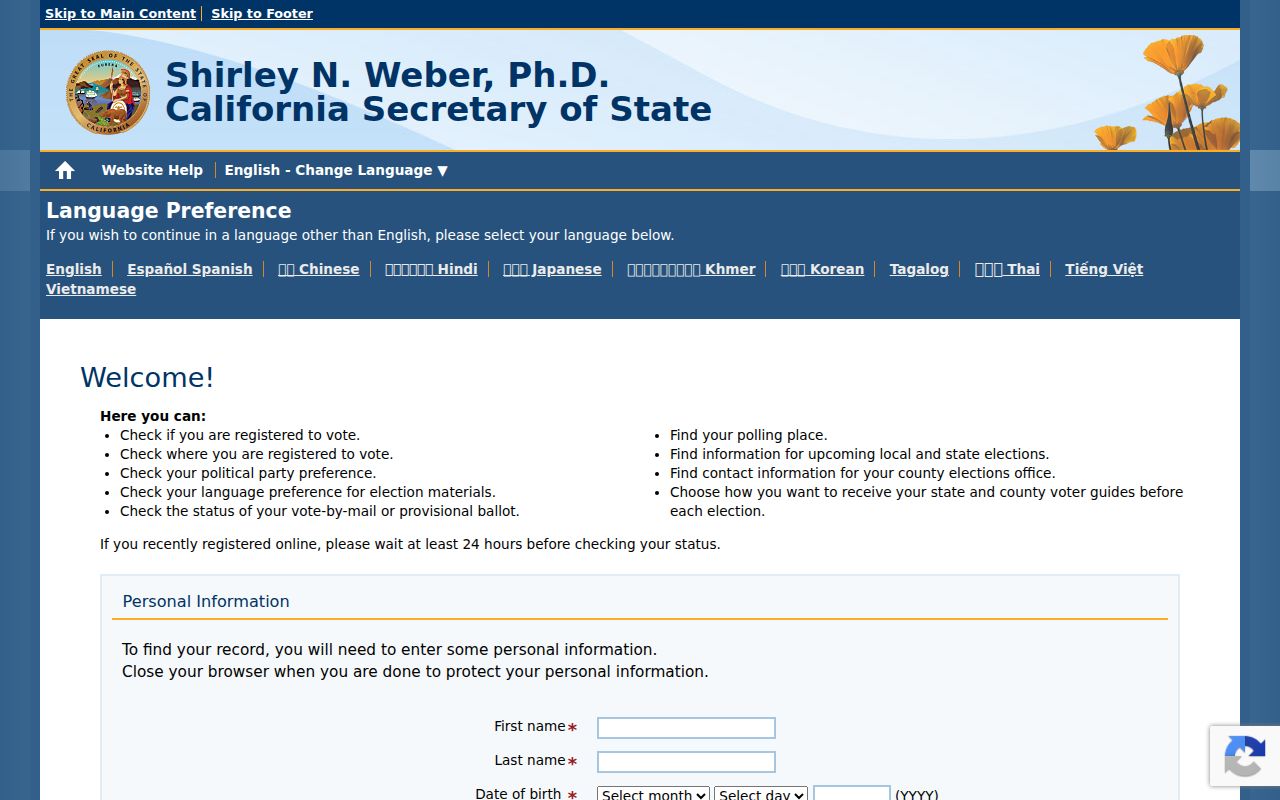
Safe at Home participants and other confidential registrations are withheld. A voter record can support a lawful, approved research purpose. Filtering a dataset by street or ZIP still does not turn it into an open block list.
Oroville Vital Records by Age
Custody of a birth or death record changes with the age of the event. Butte County Public Health registers and issues the current year plus one prior year. The Clerk-Recorder handles older county births and deaths. The California Department of Public Health is the statewide custodian. County marriages start with the Clerk-Recorder. Confidential marriages carry a special access rule under Family Code §509. California does not simply open every certificate after a set number of years. Health and Safety Code §§103525-103526 separate authorized certified copies from informational certified copies. An authorized requester proves a qualifying relationship or capacity and signs a sworn statement. Anyone may request an informational copy of most birth or death records. It is marked not valid to establish identity. Mailed authorized requests need notarization where the form requires it.
- Birth: Public Health handles the current and prior year; the Clerk-Recorder handles older local certificates. The 2026 fee is $31.
- Death: The same local custody split applies, with CDPH supplying statewide copies. The 2026 fee is $26.
- Public marriage: Start with the Butte County Clerk-Recorder or CDPH. The listed 2026 fees are $17 county and $19 CDPH.
- Dissolution certificate: CDPH supplies the $18 event certificate; Superior Court holds the file and judgment.
Before mailing anything, check the county's certificate-fee instructions and the local birth and death custody page. Fees rose by $2 at the California state level. So the 2026 amounts on the county's own pages are the ones to trust. A certificate request sent with an old fee amount will simply bounce back.
The Clerk-Recorder is the records counter where older certificates meet deeds and registrations. That is why the residents directory groups them together:
Older family research rarely needs a certificate right away. The library's pre-1905 death material, California death coverage from 1940-1997, newspapers, obituaries, cemetery evidence, church registers, and census schedules can fill most gaps. Just remember that an index is not a certificate.
Oroville Heir and Classmate Trails
An Oroville person search is often family history in disguise. The question is not always where someone lives now, but who they were connected to. Probate petitions and public notices can name a decedent, a petitioner, heirs, or devisees in one filing. An obituary adds a date, a relative, or a former town. For classmate trails, CSU Chico yearbooks and campus collections help. They reconnect people who lost touch decades ago. Write down a full name, an approximate date, and a place before any lookup begins.
Heir work has a rhythm. Start from a probate case number or a decedent name, then set the petition beside a deed and an obituary. For a classmate, use a yearbook or city directory to pin the likely year. Then test the name against court, license, business, and vital records. A single name match proves little. Keep spelling, middle initials, spouse notations, and street addresses exactly as the record printed them. Those details separate two people with one name.
Oroville's museums supply what a property roll cannot: human context. The city's museum page leads to the Pioneer History Museum, the Chinese Temple, the C. F. Lott Home, and Bolt's Antique Tool Museum. Their collections can explain a family name, a business, a building photograph, or a migration path. Arrange visits through the published contact, since not every collection is searchable online.
Historical Oroville Resident Directories
Butte County Library offers a deep historical shelf rather than a current residents directory. Digitization began with the 1881 L. M. McKinney volume, a joint CSU Chico and Butte County Library project. Surviving scans cover 1898, the 1904-05, 1907, 1909, and 1910 Chico-Oroville editions, then selected R. L. Polk years up to 1950. The run has real gaps. A missing year reflects the collection, not the disappearance of an Oroville household.
A street directory entry can carry a surname with given name or initials, a spouse in parentheses, an occupation, an employer, a home address, and marks such as `h`, `r`, or `wid`. Page 377 of the 1881 directory lists miners, merchants, a water-works agent, a jailer, widows, and acreage. Treat a directory as proof of a dated association with a place or trade. It does not prove current residence or list every soul in a household. The full collection and reading method sit on the Oroville city directory collections page.
The Butte County Library genealogy source capture shows the hub for directories, obituaries, newspapers, and death indexes:
A scan makes an old name searchable. Still, OCR must be checked against the page image. When a family trail matters, pair directory years with census schedules, deeds, permits, Sanborn maps, probate, and obituaries.
The 1852 Oroville Census Clue
California's 1852 state census is a gift for Oroville research. The 1850 federal count struggled to keep pace with Gold Rush migration. The later state census caught Butte County residents at a different moment. The State Archives holds the original. The State Library offers microfilm plus a DAR transcription or index. Search by place names as well as modern street names. Early records speak in mining-camp, river, ranch, township, or bar terms.
Oroville's own history shapes the name work. The city grew where the Feather River leaves the foothills. It served Gold Rush supply routes, and later became a railroad stop. The Chinese Temple records a Chinese community rooted in the pioneer era. The official city history includes Ishi's 1911 appearance. Record historical spellings and transliterations in a research log. Never swap an original form for a modern normalized name without noting the change.
Oroville ZIP Geography
ZIP names are not city limits. The Oroville residents directory keeps that distinction clear. The main delivery ZIPs are 95965 and 95966, yet both reach county-served and unincorporated places. Thermalito sits with 95965. Kelly Ridge, South Oroville, and Wyandotte appear with 95966 in county material. Palermo uses 95968. USPS routing, the incorporated boundary, assessor situs, and legal description are four different labels. They describe the same ground.
Verify a particular address with the USPS lookup first. Then use the city district map and county GIS to establish jurisdiction. Census QuickFacts reports 20,042 residents in the city in 2020 across 13.83 square miles. The 2024 estimate is 19,712. Those are city statistics, not a count of every 95965 or 95966 delivery address. The Oroville ZIP code directory keeps that geographic question apart from street-level parcel work.
Oroville CPRA Request Fallback
California's Public Records Act is the route when a record is not online. Government Code §§7920.000-7931.000 lets anyone ask the agency that created a file. No motive or special form is required. Describe something identifiable. A department, a date range, an address, a person, or a case number all work. The agency usually makes an initial determination within 10 calendar days. Unusual circumstances can extend that determination by up to 14 days. Even so, that window is a decision deadline, not always a production deadline.
For Oroville city records, start with the City Clerk's public-record channel when the city created the file. County records can go through the Butte County public-record request portal or straight to the named department. Ask for electronic copies and for segregable portions where that makes sense. Request a cost estimate too. A narrow description helps the custodian locate the right record. It also keeps a missed online search from hardening into a false conclusion about what exists.
Oroville Resident Records Need Context
Any Oroville residents directory worth using labels the date and purpose behind each source. The assessor answers a parcel question. The recorder points to an instrument. The court shows a case event, and the voter portal authenticates one person. A vital record confirms an eligible event, while a printed directory captures a single year. None of them is a universal household list.
Camp Fire rebuilding makes the distinction matter across Butte County. A person can keep a parcel while mail goes elsewhere. A rebuilt structure may carry a new permit trail on an older APN. A historical address may be renumbered, annexed, or described by a place name that no longer exists. Follow the legal description, the APN, the document number, and the original spelling rather than merging separate records into a story they do not prove.